
In This Article
Picture it. It’s a crisp November evening, the kids are asleep, and you slip into 102°F water under a sky full of stars. Then the blower kicks in and your tranquil soak sounds like a hairdryer duel. Not exactly the spa fantasy you paid for.
Here’s the uncomfortable truth: a quiet inflatable hot tub for backyard privacy is a real thing, but it’s a relative thing. Inflatables have no rigid insulated cabinet to muffle the motor. The air blower that makes those lovely bubbles is the loudest part of the machine. So the goal isn’t silence. It’s a tub whose heating cycle stays near a murmur, whose bubbles you can switch off when the neighbors are in earshot, and whose surroundings help hide the rest.
That’s what this guide is built around. Every pick below was chosen by comparing real specs and the aggregated sentiment in published reviews and owner feedback, not by pretending to a lab. I’ll translate each spec into what it means on your patio, and I’ll flag where noise complaints keep showing up.
A quick framing note on noise itself: sustained exposure above 85 decibels is where hearing-safety agencies like OSHA start drawing lines for workplaces. A backyard tub won’t come close to that. But “legally safe” and “pleasant at 10 p.m.” are very different bars, and your neighbor’s bedroom window sets the second one.
What Is a Quiet Inflatable Hot Tub for Backyard Privacy?
A quiet inflatable hot tub for backyard privacy is a portable, air-filled spa that pairs a low-noise heater and filter pump with a setup that keeps both sound and sightlines contained. In practice, that means a model with a well-regarded pump, bubbles you can turn off, and a placement plan that includes a privacy screen.
That definition has three moving parts, and they’re worth separating:
- The tub itself: how loud the heater, filter pump and air blower are.
- The behavior: whether you can run it heated and silent, saving bubbles for when they won’t bother anyone.
- The environment: fences, planters, distance and a privacy screen that shape what the neighbors actually see and hear.
Most shoppers fixate on the first part and ignore the other two. That’s like buying a quiet car and then driving it through a tunnel with the windows down. The strongest strategy combines all three, which is why this article spends as much time on setup and screening as on the products.
Quick Comparison: 7 Quiet Inflatable Hot Tubs at a Glance
Before the deep dives, here’s the whole field on one screen. Prices are ranges only and shift constantly, so check current price on the listing.
| Model | Seats | Jets | Noise Note (from review themes) | Price Range | Best For |
|---|---|---|---|---|---|
| Intex PureSpa Greywood Deluxe | 4-6 | 140-170 | Some reviewers praise a quiet motor | Around $700-$850 | Intex PureSpa Greywood Deluxe: quiet evening soaks |
| Bestway SaluSpa Miami AirJet | 2-4 | 120 | Pump flagged as noisy in some roundups | Roughly $450-$650 | Bestway SaluSpa Miami AirJet: couples, small patios |
| Intex PureSpa Plus | 6 | 170 | Mixed; bubble cycle is the loud part | Around $700-$800 | Intex PureSpa Plus: families wanting extras |
| Intex SimpleSpa Bubble Massage | 4 | 100 | Noisy operation is a common complaint | Budget tier | Intex SimpleSpa Bubble Massage: first-time buyers |
| Bestway SaluSpa Hawaii AirJet | 4-6 | 140 | Generally positive listing feedback | Roughly $600-$800 | Bestway SaluSpa Hawaii AirJet: all-rounder |
| Bestway SaluSpa St Moritz | Up to 7 | Not verified | Bigger tub, more pump work | Around $800-$900 | Bestway SaluSpa St Moritz: large groups |
| Wave 130 Jet 6-Person | 6 | 130 | Integrated heater marketed as quieter; feedback mixed | Mid-range, verify | Wave 130 Jet 6-Person: experimenting with design |
Look at the pattern. The tubs with the best noise reputation are the ones where owners can run the heater without the blower, which is exactly what low-noise soaking depends on. Intex PureSpa Greywood Deluxe earns the quiet-motor chatter, while Intex SimpleSpa Bubble Massage and Bestway SaluSpa Miami AirJet both draw noise criticism. If you’re budget-bound, budget a little for a sound-and-sight barrier too.
💬 Just one click — help others make better buying decisions too!😊
Top 7 Quiet Inflatable Hot Tubs: Expert Analysis
1. Intex PureSpa Greywood Deluxe — best for quiet evening soaks
This is the model most often singled out when reviewers talk about a quieter motor, which makes it the natural starting point for a hunt like this one.
It comes in a 4-person version (roughly 210 gallons, 140 jets) and a 6-person version (roughly 290 gallons, 170 jets), with a fiber-tech interior that helps it hold its shape when full. In practice, the stiffer structure means less wall flex and a more stable feel. App control and a hard-water treatment system round things out, and the app matters more than it sounds: you can preheat from the couch instead of letting the heater labor on a cold night.
Based on the spec comparison, this suits people who soak in the evening and want heating handled before they step outside. The bigger the water volume, the longer the first heat-up runs, so plan that noisy stretch for daytime.
Reviewers on retail listings are mixed overall (ratings sit in the high-3s on one major listing at the time of research), but noise comments skew favorable relative to the field. Treat that as a tendency, not a guarantee.
Pros:
- ✅ Frequently described as having a quieter motor
- ✅ Sturdy fiber-tech construction holds its shape
- ✅ App control lets you preheat in advance
Cons:
- ❌ Costs more than entry-level inflatables
- ❌ Bubble cycles still add noticeable sound
Expect around $700-$850; it’s the strongest quiet-focused value here if you’ll actually use the preheat feature.
2. Bestway SaluSpa Miami AirJet — most compact, with a noise caveat
The Bestway SaluSpa Miami AirJet shrinks the whole experience into a footprint that tucks beside a fence, which helps with both privacy and sound.
It’s rated as a 2-4 person tub and many reviewers feel it’s happiest at two or three, with 120 AirJets, a digital control panel, Freeze Shield technology and EnergySense insulation. That insulation does double duty: it holds heat longer, so the heater cycles less often, and fewer cycles means fewer noise events overnight. A programmable timer lets you warm the water on a schedule rather than all day.
Here’s what to weigh. One roundup specifically calls the included pump noisy compared with other models, so this isn’t the pick for someone whose neighbor’s bedroom window faces the patio. It is a smart pick for a couple with a corner spot, a solid fence and a plan to keep the bubbles to short bursts.
Aggregated feedback is warm on value and easy setup, cooler on pump sound.
Pros:
- ✅ Compact footprint fits tight patios
- ✅ Insulation and timer reduce heater cycling
- ✅ Strong value for couples
Cons:
- ❌ Pump noise flagged in some reviews
- ❌ Realistically seats two or three, not four
Typically about $450-$650; a good-value verdict, provided you pair it with a sound barrier.
3. Intex PureSpa Plus — best for families who want the extras
If the Intex PureSpa Plus feels like a lot of tub, it is. This is the model for people who want the accessories bundled in.
It’s a 6-person round with 170 jets and a saltwater-compatible system on some versions, and reviewers point to headrest pillows and LED lighting as differentiators against cheaper competitors. Those lights matter more than they seem: at night, ambient glow lets you soak without bright patio floodlights, which advertises your presence to the whole block.
More jets and more water mean a hardworking pump and blower. When the full bubble system runs, expect it to be one of the louder profiles in this lineup. The honest recommendation is to treat bubbles as a feature for daytime or early evening, then switch to heat-only for the late soak.
Owner feedback is generally positive on comfort and extras, with noise coming up as a mixed bag.
Pros:
- ✅ Roomy six-person seating
- ✅ LED lighting and headrests included
- ✅ 170 jets deliver a full massage
Cons:
- ❌ Bubble cycle is among the louder profiles
- ❌ Large footprint needs a bigger screening plan
Around $700-$800; worth it if the extras matter to you more than absolute quiet.
4. Intex SimpleSpa Bubble Massage — the budget way to get started
Everyone has to start somewhere, and the Intex SimpleSpa Bubble Massage is where plenty of first-time buyers do.
It’s a 4-person round with about 71 inches of interior diameter, 100 jets, horizontal beams for structural support and an internal pump. That internal pump is a design choice with a trade-off: fewer external parts to fuss with, but less flexibility to relocate noise away from your seat. Some outlets also note error codes appearing on the control panel in customer complaints.
Reviewers specifically flag noisy operation here. So if quiet is the top priority, this is the weakest match on the list. It earns a place because it’s the cheapest way to see whether you’ll actually use a hot tub, and you can offset the noise with placement, a screen and a bubbles-off habit.
Summarized sentiment: a sweet spot for affordability, with noise and longevity chatter along the way.
Pros:
- ✅ Lowest barrier to entry
- ✅ Sturdy horizontal beam construction
- ✅ Simple setup for beginners
Cons:
- ❌ Noisy operation is a recurring complaint
- ❌ Control-panel error codes reported
Budget tier (check current price); a fair verdict if you accept the noise trade-off.
5. Bestway SaluSpa Hawaii AirJet — the dependable all-rounder
The Bestway SaluSpa Hawaii AirJet is the “nobody got fired for buying it” option: solid size, solid jets, solid reputation.
It seats 4-6 with around 140 AirJets, and some versions add app control. App control is the sleeper feature again. It means you can schedule heating in daylight hours and arrive to warm water with the blower silent. Notably, retail listings for the AirJet version show noticeably positive ratings (in the mid-4s on one major listing at research time), which beats several rivals here.
On paper this is the model I’d point to when someone wants room for friends and doesn’t want to pay Greywood money. Its noise story is typical for AirJet systems: a calm heating phase and a loud-ish bubble phase.
Review themes lean positive on heat retention and jet coverage, with the usual blower sound noted.
Pros:
- ✅ Well-rated across retail listings
- ✅ App-control versions allow daytime preheating
- ✅ Room for four to six
Cons:
- ❌ Blower is audible during bubble cycles
- ❌ Heavier when full, so prep a level base
Roughly $600-$800; strong value, and a safe default if you’re torn.
6. Bestway SaluSpa St Moritz — best for big groups
Need to fit seven people? The Bestway SaluSpa St Moritz is the volume play.
It’s pitched for up to seven people with about 314 gallons of water. Sheer volume is the key variable here. More water holds heat once it’s there (good for fewer heater cycles), but it also takes longer to heat and puts more demand on the pump. In other words, the noisy phase lasts longer, so schedule it during the day.
I’d call this the right choice for entertaining and the wrong one for stealthy solo late-night soaks. A tub this large is also tough to hide: it needs real screening and a firm, level surface, because a full tub of this size weighs a lot.
Feedback is focused on capacity and comfort for groups, with little specific noise data to verify, so don’t assume it’s quiet.
Pros:
- ✅ Seats up to seven
- ✅ Large volume holds heat well
- ✅ Great for gatherings
Cons:
- ❌ Long first heat-up means longer noisy phase
- ❌ Hard to screen from view
Near the $900 mark or a bit under; expensive for a quiet-first buyer, great for crowds.
7. Wave 130 Jet 6-Person — the integrated-heater experiment
The Wave 130 Jet 6-Person takes a different engineering approach, and that makes it the wild card.
Instead of an external pump-and-heater box, it uses a built-in integrated heater designed to be tidier and, according to the maker, quieter in running noise. A 130-jet bubble system and a roughly 1350W eco heater (on related versions) keep the power draw moderate. Fewer boxes on the patio also means fewer places for sound to leak out.
Here’s the caution. The maker’s quiet claim is marketing, and independent evidence is thin. One buyer review of a related inflatable measured heater noise in the high 50s dB and bubble noise in the 70s. That’s a reminder to verify with your own phone’s decibel app after setup.
Sentiment is hard to generalize: some owners praise durability and relaxation, while others raise noise.
Pros:
- ✅ Integrated heater cuts box clutter
- ✅ Marketed as quieter running
- ✅ Six-person capacity
Cons:
- ❌ Quiet claims lack independent confirmation
- ❌ Limited review data to lean on
Mid-range pricing (check current price); promising, but I’d test before trusting the claim.
Transformation Guide: The Quiet-Setup Playbook for Your First 30 Days
Most noise problems aren’t the product’s fault. They’re setup mistakes you can fix for free.
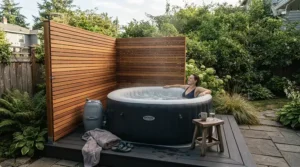
Week one: placement. Put the tub on level ground, as far from your neighbor’s bedroom as your yard allows. Pump vibration travels through hard surfaces, so a deck or balcony will amplify it, while a ground cloth over grass or gravel absorbs it. Slide the pump on a rubber mat or foam pad.
Week two: water level. Keep the water at the proper line. Water that’s too high or too low makes the pump and jets work harder and louder. While you’re there, clean or swap the filter cartridges; a clogged filter forces the pump to strain.
Week three: habits. Heat during the day, soak at night with the bubbles off, and use the blower for ten-minute bursts instead of an hour straight. This is the single biggest quiet lever you have.
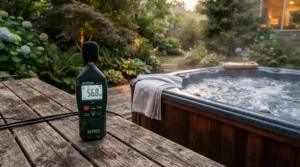
Week four: measure. Download a free decibel meter app and measure at your property line, not at the tub. That’s the number your neighbors live with.
Common first-month mistakes include running bubbles at midnight, leaving the cover off (which wastes heat and makes the heater cycle more), and skipping the ground cloth. Fix those three and most tubs get noticeably calmer.
Real-World Scenarios: Matching the Tub to Your Backyard
Specs are abstract. Backyards are not. Here are three profiles, with reasoning.
The couple with a narrow side yard. Two adults, a 6-foot fence, one close neighbor, evening soaks only. A compact tub like the Bestway SaluSpa Miami AirJet fits the footprint, and a solid fence plus a bubbles-off habit handles most of the noise. Budget stays modest, leaving room for a privacy screen.
The family with a wide lot. Four to six people, weekend use, lots of space to the property line. The Bestway SaluSpa Hawaii AirJet or Intex PureSpa Plus offer room and jets, and distance does the noise-dampening for free. Schedule bubble time for afternoons.
The noise-sensitive suburban soaker. Late-night use, close neighbors, a strong preference for calm. The Intex PureSpa Greywood Deluxe is the most defensible pick based on review themes, paired with app-based preheating and a full privacy screen. If budget pinches, the Intex SimpleSpa Bubble Massage can work, but only with disciplined habits and serious screening.
In each case, frequency of use matters. If you’ll soak four nights a week, spend more on the quieter model. If you’ll soak twice a month, a cheaper tub plus good manners is smarter.
Problem and Solution: Fixing the Five Most Common Noise Complaints
Problem 1: The blower is too loud. Solution: run it in short bursts and turn it off for the final part of the soak. Most of the heavy sound is the air system, not the heater.
Problem 2: A low grumbling hum. Solution: a pump starved for water often makes a low-pitched grumble, so check the water level and clear any blockage in the intake.
Problem 3: Rattling or buzzing. Solution: loose bolts, base screws or a vibrating surface are common culprits. Re-seat the pump on a foam pad and tighten what you can.
Problem 4: The heater runs constantly in cold weather. Solution: use the insulated cover every time, and consider a windbreak. Cold air makes the heater cycle more, and more cycling means more sound.
Problem 5: Neighbors can hear voices. Solution: noise isn’t just machinery. A screen with mass, like a solid fence, helps more than a decorative one.
For example, the Bestway SaluSpa Miami AirJet benefits most from fixes one and three, while the larger Bestway SaluSpa St Moritz needs fix four more than the rest. Match the fix to the tub and you’ll solve most complaints without replacing anything.
How to Choose a Quiet Inflatable Hot Tub: 7 Steps
Here’s the short version, in order of importance.
- Look for a separate-switch blower. You want to run heat without bubbles. If you can’t, the tub fails the quiet test immediately.
- Read noise comments, not star ratings. A 4.5-star tub can still be loud. Search reviews for words like “loud,” “hum” and “vibration.”
- Prefer app or timer control. Preheating at noon beats heating at 9 p.m. next to a bedroom window.
- Match size to real use. Bigger tubs run their pumps longer. Don’t buy six seats for two people.
- Check insulation and cover quality. Better heat retention means fewer heater cycles, and fewer cycles mean quieter nights.
- Plan the surface. Hard decks carry vibration; grass and ground cloths soften it.
- Budget for screening. A privacy screen and a rubber pump mat often improve your experience more than upgrading the tub.
The reasoning behind that order: noise has three sources (machine, behavior, environment), and the cheapest fixes live in the last two. Spend your money on the first only when you’ve exhausted the others. For deeper product comparisons from an established outlet, Popular Science’s inflatable hot tub reviews are a useful second opinion.
Decibel Level: What the Numbers Actually Mean at Your Fence Line
Decibel level is the most misunderstood number in this whole conversation, so let’s demystify it.
For context: a whisper is around 30 decibels, normal conversation sits at roughly 60 to 70, and a lawnmower is near 90. Published guides suggest quieter hot tubs run roughly 40-60 dB, while standard tubs without noise reduction can land at 65-75 dB.
Now the key subtlety: the scale is logarithmic. A 10 dB jump is about ten times the sound intensity and roughly a doubling in perceived loudness. So a heater at 58 dB and a blower at 75 dB isn’t a “bit louder.” It’s a dramatic jump.
That lines up with what owners report. One buyer of an inflatable spa measured about 58-60 dB while heating and 73-80 dB with bubbles running, comparing the latter to a vacuum cleaner. Another owner described heating as unobtrusive but bubbles as hairdryer-like. Not scientific, but consistent.
The practical takeaway: judge a tub by its heat-only decibel level, because that’s what runs for hours. Then treat bubble mode as a feature you ration. And since distance and fences reduce what reaches the neighbor, measure at your property line. If you want to understand why long exposure at higher levels matters for hearing, the CDC’s hearing health overview is a solid read.
Pump Noise: Why Inflatable Hot Tubs Get Loud (and What You Can Do)
Pump noise comes from a few distinct sources, and knowing which is which tells you what to fix.
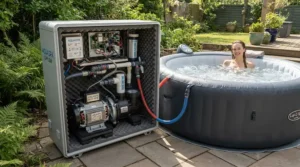
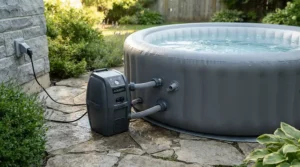
The heater and filter pump circulates water and warms it. It’s usually the quieter component. The air blower pushes air through the jets to create bubbles. It’s usually the loudest. A third source is vibration, which happens when either unit shakes against a hard surface and turns the whole patio into a speaker.
Smaller, less powerful tubs tend to run quieter, and quality components generally help. But inflatable spas are built to a price, and the pump is where corners get cut. That’s why some roundups flag pump noise as a downside and why a few mention premature pump wear on certain models.
Here are the highest-impact fixes:
- Put a rubber or foam pad under the pump unit.
- Keep the water level correct so the pump isn’t starved or over-pushed.
- Replace dirty filters promptly.
- Keep jets clear of blockages.
- Keep the pump unit away from reflective hard surfaces like brick walls, which bounce sound back.
None of this turns an inflatable into a silent acrylic spa. But in combination, these steps can move a noisy tub into the “perfectly acceptable” bracket. The mindset shift is simple: you’re not shopping for silence, you’re managing sound.
Building a Privacy Screen That Also Softens Sound
A privacy screen solves the visual half of the equation, and with the right design, a good chunk of the audio half too.
Bamboo fencing is affordable, comes in rolls and looks great, though it’s an organic material that weathers and needs replacing. It blocks views well; sound reduction is modest. Lattice with climbing plants (clematis, jasmine, ivy) builds a living wall that improves over time, and lattice alone reduces visibility without blocking sun. Tall planters with bamboo, ornamental grasses or arborvitae are portable and flexible, which suits renters. Pergolas with outdoor curtains add overhead cover, which matters if neighbors have a second-story view.
On the sound front, mass is what counts. A solid wood fence outperforms an airy screen, and dense evergreens help a little, but don’t expect plants to act like a wall. Be mindful that some plants drop leaves into the water, increasing maintenance.
Two practical cautions. First, check your HOA rules and local ordinances before building anything permanent. Second, keep a gap for airflow around the pump so it doesn’t overheat. A well-chosen privacy screen turns a tub in the open into a retreat, and it costs far less than upgrading to a premium spa.
Quiet Inflatable vs Traditional Hard-Shell Hot Tubs
Let’s be fair about what you give up and what you gain.
| Factor | Quiet Inflatable | Traditional Hard-Shell |
|---|---|---|
| Upfront cost | Hundreds to about $900 | Thousands |
| Typical noise | Quiet heating, loud bubbles | Often better insulated, can still hum |
| Setup | Hours, no electrician | Delivery, pad, wiring |
| Portability | Deflate and store | Fixed |
| Best For | Renters, trial buyers, seasonal users | Long-term owners wanting quiet |
Looking at the table, the real advantage of an inflatable is flexibility and entry cost, not sound. Premium hard-shell spas can be engineered for very low noise, and some brands build their whole pitch around a whisper-quiet circulation pump. If your priority is the quietest possible tub for years, that’s the right category.
But if you’re renting, unsure about commitment or working with a modest budget, an inflatable plus smart screening gets you most of the way there. Models like the Intex PureSpa Greywood Deluxe close the gap on heat-phase noise, while the bubble phase remains the compromise. Think of it as renting calm instead of buying it.
Low Noise Inflatable Spa for Evening Soaks: A Routine That Works
A low noise inflatable spa for evening soaks lives or dies on routine more than hardware.
Start at midday. Warm the water while the neighborhood is noisy anyway: lawn equipment, traffic and kids. By evening, the water is at temperature and the heater is mostly idle. When you step in, leave the blower off at first. Your ears will adjust to the quiet and you’ll notice how restful a heat-only soak really is.
Use bubbles in short, deliberate bursts, then switch off. If you’ve got an app-enabled model like the Bestway SaluSpa Hawaii AirJet or the Intex PureSpa Greywood Deluxe, you can schedule all of this without leaving the couch.
Cold weather changes the equation. In November the heater works harder, so use the insulated cover religiously and consider a wind screen. A well-insulated tub cycles less, and fewer cycles mean fewer sound events at night.
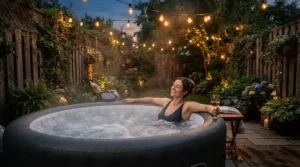
One last tip: add warm, low lighting rather than bright floods. Soft light keeps the mood calm and doesn’t announce your soak to the whole block. Quiet, after all, isn’t only about decibels. It’s about the whole atmosphere you’re building.
Choosing an Inflatable Hot Tub with a Quiet Pump: Features That Matter (and Those That Don’t)
When shopping for an inflatable hot tub with a quiet pump, marketing language can drown out the signal. Here’s how to sort it.
Features that matter:
- Independent blower control. Heat without bubbles is the foundation of quiet.
- Timer or app scheduling. It shifts noisy heating to daylight.
- Insulation and a good cover. Less heat loss, fewer cycles.
- Filter access. Easy cartridge swaps keep the pump from straining.
- Internal vs external pump design. Integrated designs, like the one on the Wave 130 Jet 6-Person, aim for tidier and quieter operation, though independent proof is limited.
Features that matter less than advertised:
- Raw jet count. Whether it’s 100 jets or 170, more bubbles can mean a bigger blower and more noise.
- Fancy LEDs. Nice, but they do nothing for decibels.
- Capacity beyond your needs. The Bestway SaluSpa St Moritz is great for crowds and overkill for two.
The honest summary: a mid-range pump in a well-insulated tub, run sensibly, beats a flashy model run carelessly. And if a seller can’t point to any real noise information, treat quiet claims as unproven until owners say otherwise.
Long-Term Cost and Maintenance: What a Quiet Tub Really Costs
Sticker price is only the opening bid. Total cost of ownership is where tubs separate.
| Cost Factor | Lower-End Pick | Higher-End Pick |
|---|---|---|
| Purchase | Intex SimpleSpa Bubble Massage: budget tier | Bestway SaluSpa St Moritz: around $800-$900 |
| Electricity | Moderate with good cover | Higher for large volume |
| Filters and chemicals | Ongoing, similar | Ongoing, scales with volume |
| Noise mitigation | Screen and pad needed | Screen needed regardless |
| Best For | Trial buyers | Group entertainers |
The table makes the key point: operating costs track water volume and insulation more than brand. A smaller, well-insulated tub like the Bestway SaluSpa Miami AirJet costs less to keep warm than a giant, and its power-saving timer helps. Meanwhile, the Intex PureSpa Greywood Deluxe may cost more upfront but offers smarter scheduling that cuts wasted heating.
Maintenance also protects quiet. Swap filters on schedule, keep water chemistry balanced, and don’t ignore small rattles. Neglected pumps get louder and fail sooner, and one roundup specifically warns about pump failure in the first year on certain models. Over three seasons, a modest screen, a pump mat and routine filter changes typically cost less than replacing a burned-out pump.
Safety, Temperature and Neighbor Rules
Quiet is pointless if the soak isn’t safe. Start with temperature: the Consumer Product Safety Commission advises never exceeding 104°F, with 100°F considered safe for most healthy adults. Thermostats can be off by several degrees, so check with an accurate thermometer before you get in.
Electrical safety matters outdoors. Use a properly rated GFCI outlet, keep cords away from standing water, and never use extension cords unless the manual allows it. Always use a locked cover when the tub’s not in use, especially with children around, and avoid alcohol while soaking. Pregnant women and young children should talk to a physician first.
On the neighbor front, noise ordinances vary by city and some HOAs restrict hot tubs or screens. Check local rules before you place the tub and before you build a screen. A friendly heads-up to the closest neighbors goes a long way, too: people tolerate noise far better when they’ve been told what to expect.
Finally, place the tub on a level, firm surface rated for the filled weight. A full tub is heavy, and a sagging base stresses seams and makes pumps work awkwardly. Safety, quiet and longevity all start from the same place: a good foundation.
Frequently Asked Questions
❓ How loud is an inflatable hot tub at night?
❓ Can neighbors hear an inflatable hot tub through a fence?
❓ Is there a completely silent inflatable hot tub?
❓ What's the best privacy screen for a hot tub?
❓ Do inflatable hot tubs need a GFCI outlet?
Conclusion: Calm Is a Combination, Not a Product
So, can you really get a quiet inflatable hot tub for backyard privacy? Yes, if you define quiet honestly. You won’t find a silent inflatable, but you can build a calm, private soak by combining the right tub, smart habits and a thoughtful screen.
If I had to boil the field down: the Intex PureSpa Greywood Deluxe is the quiet-first pick based on review themes, the Bestway SaluSpa Hawaii AirJet is the dependable all-rounder, and the Bestway SaluSpa Miami AirJet is the compact value play with a pump-noise caveat. The Intex PureSpa Plus suits families who want extras, the Bestway SaluSpa St Moritz suits crowds, the Intex SimpleSpa Bubble Massage is the budget entry, and the Wave 130 Jet 6-Person is the integrated-heater experiment worth verifying yourself.
Whatever you choose, remember the formula: heat in the daytime, soak at night with the bubbles off, put a pad under the pump, and invest in a privacy screen. Do that, and your evening soaks will sound like what they should: almost nothing at all.
Recommended for You
- [Add your blog post link 1]
- [Add your blog post link 2]
- [Add your blog post link 3]
Disclaimer: This article contains affiliate links. As an Amazon Associate, I earn from qualifying purchases. If you purchase products through these links, we may earn a small commission at no additional cost to you.
✨ Found this helpful? Share it with your friends! 💬🤗
